Because the Olympic break involves an finish, I needed to do a particular version of Analytics Benefit. This week is cut up into two elements. First, I put collectively a “what if” situation: what the NHL All Star Recreation may need seemed like this season if it was hosted on Lengthy Island. Second, I shift right into a Tableau visualization that highlights the highest five-on-five gamers this 12 months, utilizing a number of totally different graph angles to indicate which skaters have pushed play and produced on the highest degree at even energy.
The All Star portion just isn’t meant to be an ideal projection. In a typical format, 32 gamers are chosen initially, then 12 extra gamers are voted in by followers. Accidents, replacements, and gamers opting out can change the ultimate rosters as nicely. With that in thoughts, that is nonetheless a powerful snapshot of what an All Star weekend in New York might have seemed like this season primarily based on efficiency and star energy.
All Star Snubs
Observe: 32 gamers are chosen initially, then 12 are voted in by followers, with extra adjustments potential attributable to accidents and replacements.
Snubs: Cutter Gauthier (ANA), Morgan Geekie (BOS), Charlie McAvoy (BOS), Tage Thompson (BUF), Brock Nelson (COL), Jason Robertson (DAL), Miro Heiskanen (DAL), Wyatt Johnston (DAL), Alex DeBrincat (DET), Dylan Larkin (DET), Brad Marchand (FLA), Cole Caufield (MTL), Matt Boldy (MIN), Filip Gustavsson (MIN), Ryan O’Reilly (NSH), Jake Guentzel (TBL), Darren Raddysh (TBL), Brandon Hagel (TBL), Auston Matthews (TOR), Nick Schmaltz (UTA), Mitch Marner (VGK), Kyle Connor (WPG).
I doubtless missed a number of, so you probably have a favourite snub, be at liberty to drop it within the feedback.
Mock All Star Groups
Atlantic Division
• Boston Bruins: David Pastrnak (F), Jeremy Swayman (G)
• Buffalo Sabres: Rasmus Dahlin (D)
• Detroit Crimson Wings: Lucas Raymond (F)
• Florida Panthers: Sam Reinhart (F)
• Montreal Canadiens: Nick Suzuki (F), Lane Hutson (D)
• Ottawa Senators: Tim Stutzle (F)
• Tampa Bay Lightning: Nikita Kucherov (F), Andrei Vasilevskiy (G)
• Toronto Maple Leafs: William Nylander (F)
Metropolitan Division
• Carolina Hurricanes: Sebastian Aho (F)
• Columbus Blue Jackets: Zach Werenski (D)
• New Jersey Devils: Nico Hischier (F)
• New York Rangers: Mika Zibanejad (F)
• New York Islanders: Mathew Barzal (F), Matthew Schaefer (D), Ilya Sorokin (G)
• Philadelphia Flyers: Travis Konecny (F)
• Pittsburgh Penguins: Sidney Crosby (F)
• Washington Capitals: Jakob Chychrun (D), Logan Thompson (G)
Central Division
• Chicago Blackhawks: Connor Bedard (F)
• Colorado Avalanche: Nathan MacKinnon (F), Cale Makar (D), Martin Necas (F)
• Dallas Stars: Mikko Rantanen (F)
• Minnesota Wild: Quinn Hughes (D), Kirill Kaprizov (F)
• Nashville Predators: Juuse Saros (G)
• St. Louis Blues: Joel Hofer (G)
• Winnipeg Jets: Mark Scheifele (F)
• Utah Mammoth: Clayton Keller (F)
Pacific Division
• Edmonton Oilers: Connor McDavid (F), Evan Bouchard (D), Leon Draisaitl (F)
• Anaheim Geese: Lukas Dostal (G)
• Seattle Kraken: Jordan Eberle (F)
• Calgary Flames: Dustin Wolf (G)
• Los Angeles Kings: Adrian Kempe (F)
• San Jose Sharks: Macklin Celebrini (F)
• Vancouver Canucks: Filip Hronek (D)
• Vegas Golden Knights: Jack Eichel (F), Mark Stone (F)
High 5-on-5 Gamers This Season (Tableau Visualization)
The second a part of this week’s version is a Tableau-driven have a look at the highest five-on-five performers this season. The purpose is to isolate true even-strength influence and present which gamers have been driving outcomes when groups are enjoying actual hockey with out energy play inflation. Every chart highlights a distinct angle of five-on-five efficiency, so as an alternative of counting on one metric to inform the entire story, the visuals assist separate quantity shooters from effectivity scorers, play drivers from passengers, and sustainable profiles from gamers working scorching.
Graph 1: Blowouts
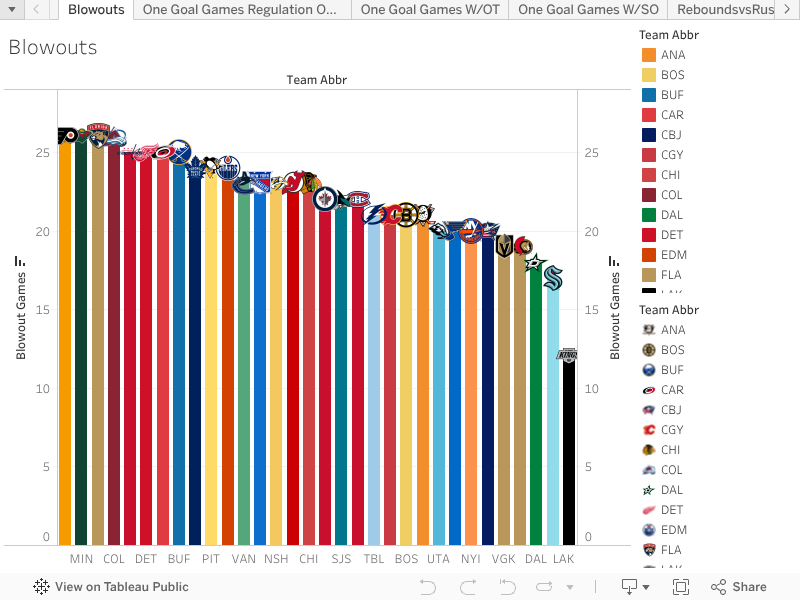
This blowout view is a fast snapshot of which groups have been concerned in probably the most lopsided video games in 2025-26, and it really works in each instructions. A group can present up right here as a result of they’re usually getting blown out, or as a result of they’re those creating separation and working groups off the ice. Philadelphia sits close to the highest of this record, which inserts the profile of a group that has had loads of tough nights. Minnesota and Colorado additionally present up closely, however their context may be very totally different, as these groups have had stretches the place they will put video games away early when the offense is rolling. On the different finish, Los Angeles stands out as one of many groups holding video games tighter extra typically, with fewer outcomes that flip into true runaways.
Graph 2: One-Aim Video games (Regulation Solely)
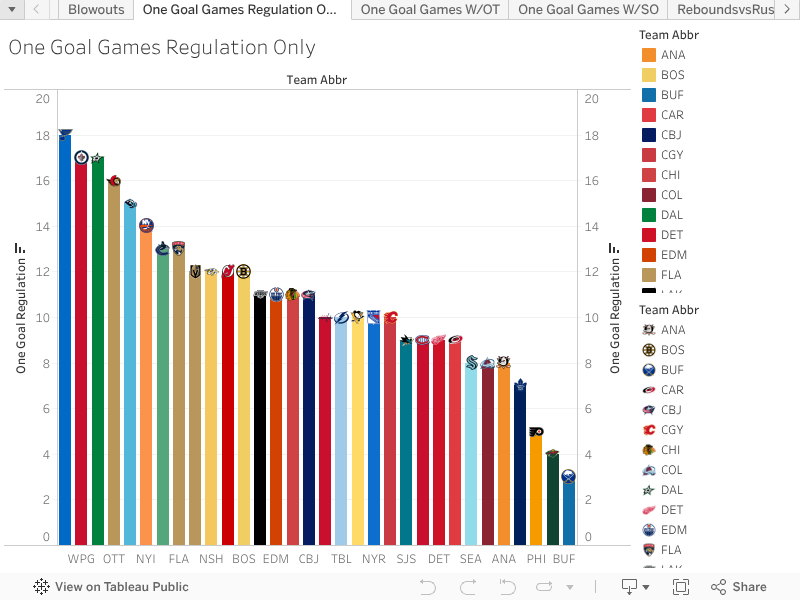
This graph isolates video games that led to regulation with a one-goal margin, which is beneficial as a result of it filters out time beyond regulation and focuses strictly on tight video games in 60 minutes. St. Louis and Winnipeg present up as groups dwelling on this area, which traces up with the concept that a lot of their video games are determined late. Dallas seems continuously as nicely. In the meantime, groups that present up within the blowout bucket, like Philadelphia and Minnesota, usually are not practically as distinguished right here, suggesting their outcomes have been much less coin-flip and extra swing-y. Buffalo additionally stands out as a group that has not performed many regulation one-goal video games, which means they haven’t been in as many tight 60-minute finishes because the groups close to the highest of the record.
Graph 3: One-Aim Video games (Together with OT)
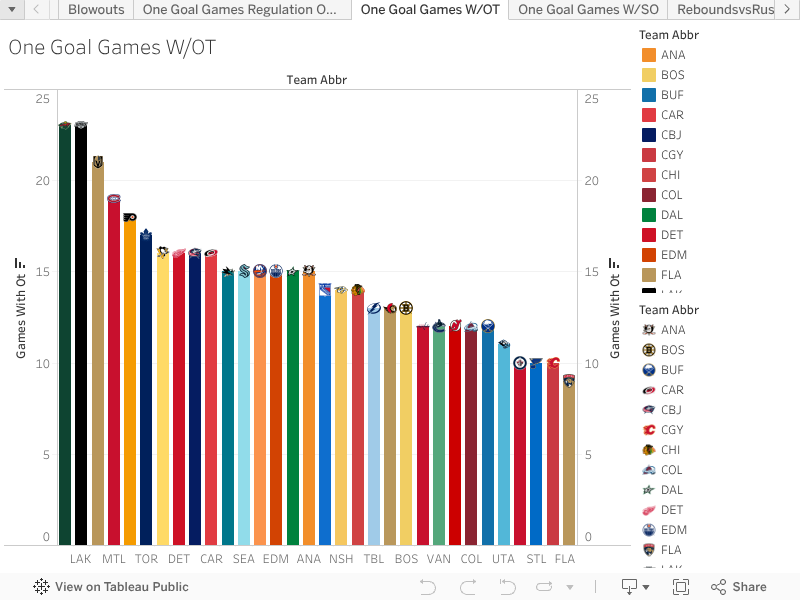
When you increase to incorporate time beyond regulation, the additional time tendencies pop instantly. Minnesota and Los Angeles stand out as groups which have performed plenty of one-goal video games that go previous regulation, which inserts the identification of lower-event, tighter video games that keep shut into the third interval. Florida sits a lot decrease on this view, suggesting their outcomes have been extra decisive and fewer prone to drift into time beyond regulation. You additionally see a number of groups which have struggled this season present up extra right here, which may replicate groups that dangle round longer than anticipated, or groups that can’t constantly shut video games cleanly in regulation.
Graph 4: Shootouts
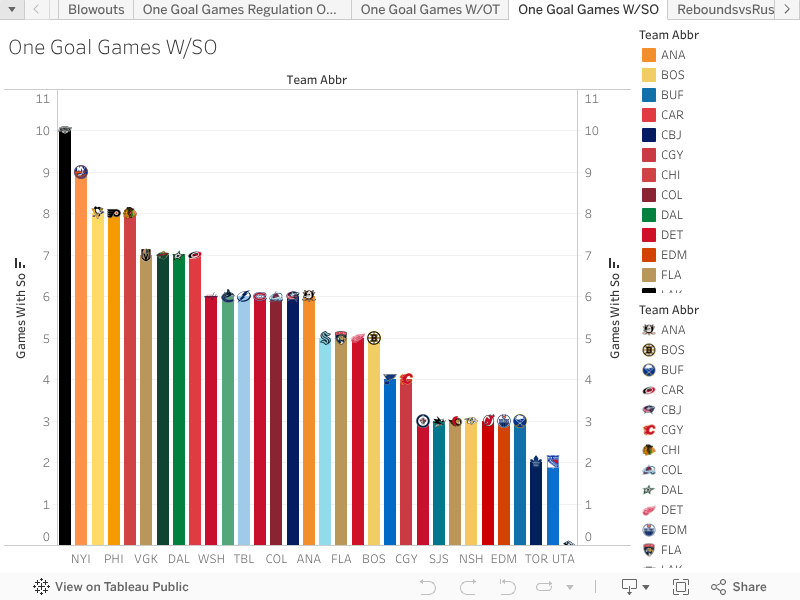
The shootout view is mainly probably the most excessive model of holding video games shut. Los Angeles exhibits up once more as a group that has been in plenty of shootouts, which tracks with every part we see about how typically their video games keep tight. One fascinating notice from the 2025-26 information: Utah stands out as a group that has not been to a shootout in any respect this season. It’s not a ability takeaway by itself, however it’s a actual schedule quirk that exhibits how otherwise groups can get to their outcomes, even when they’re enjoying the same variety of shut video games total.
Graph 5: Rebounds vs Rush Makes an attempt (Per 60)
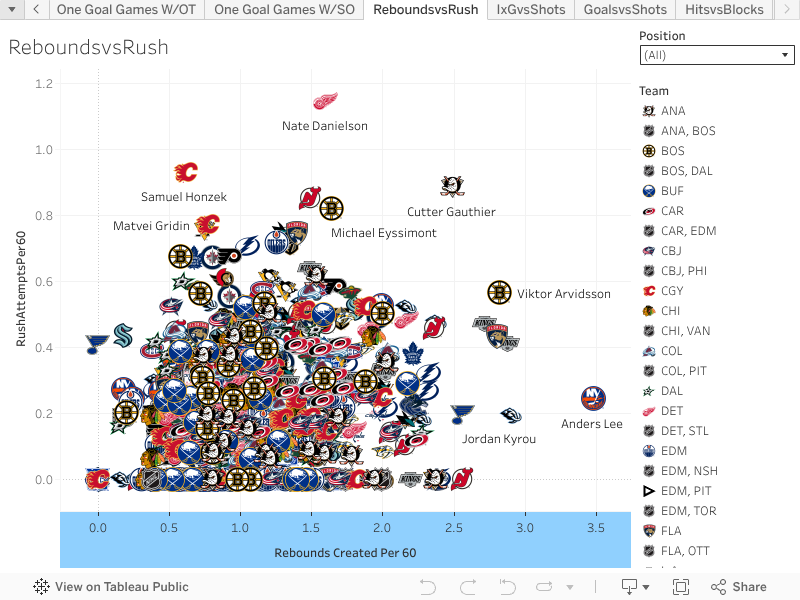
This participant chart seems to be at Rebounds/60 towards Rush Makes an attempt/60, which is a clear solution to spotlight who’s actively pushing play in transition and nonetheless attending to harmful second-chance areas. The gamers clustered within the upper-right quadrant are those who constantly carry the puck with tempo and switch it into actual offense, both by creating chaos across the internet or by being instantly concerned in possibilities off the push. Names like Cutter Gauthier, Viktor Arvidsson, Anders Lee, and Nate Danielson stand out right here as gamers who’re continuously concerned when their groups assault with velocity. The takeaway is easy: when these guys have the puck and area, they don’t seem to be simply skating it up the ice, they’re turning that rush quantity into possibilities that create follow-up alternatives.
Graph 6: Particular person xG/60 vs Pictures/60
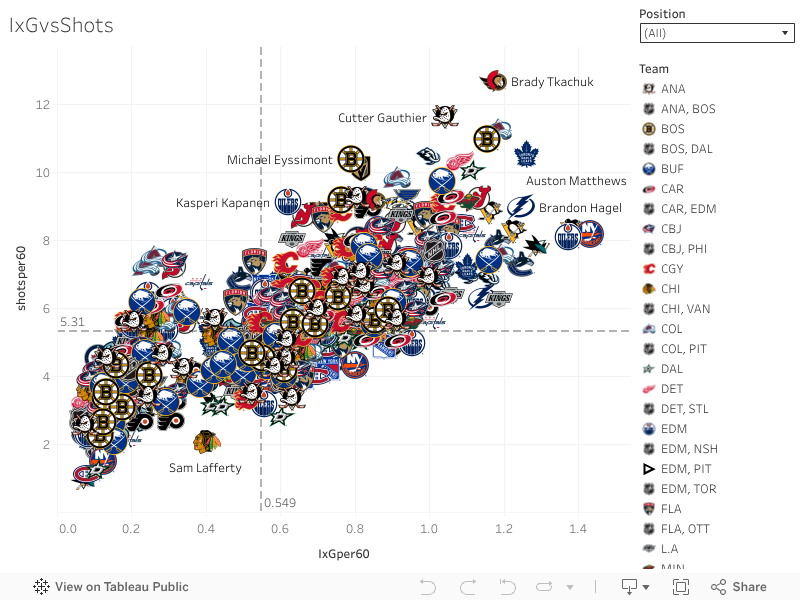
This chart plots Particular person Anticipated Targets For/60 towards Pictures/60. It’s primarily a shot quantity plus likelihood high quality view, and the upper-right nook is the candy spot: gamers who hearth a ton and generate harmful seems to be whereas doing it. Brady Tkachuk jumps out as a basic instance of a participant who consistently pushes the tempo and generates quantity, and also you additionally see sturdy five-on-five engines like Cutter Gauthier, Viktor Arvidsson, Ross Colton, Alex DeBrincat, Jason Robertson, Dylan Guenther, Auston Matthews, Brandon Hagel, Matt Boldy, and Seth Jarvis displaying up as nicely. When a participant is excessive in each pictures and particular person xG, it normally means they don’t seem to be simply floating perimeter makes an attempt, they’re repeatedly moving into the forms of areas that translate into objectives.
Graph 7: Targets/60 vs Pictures/60
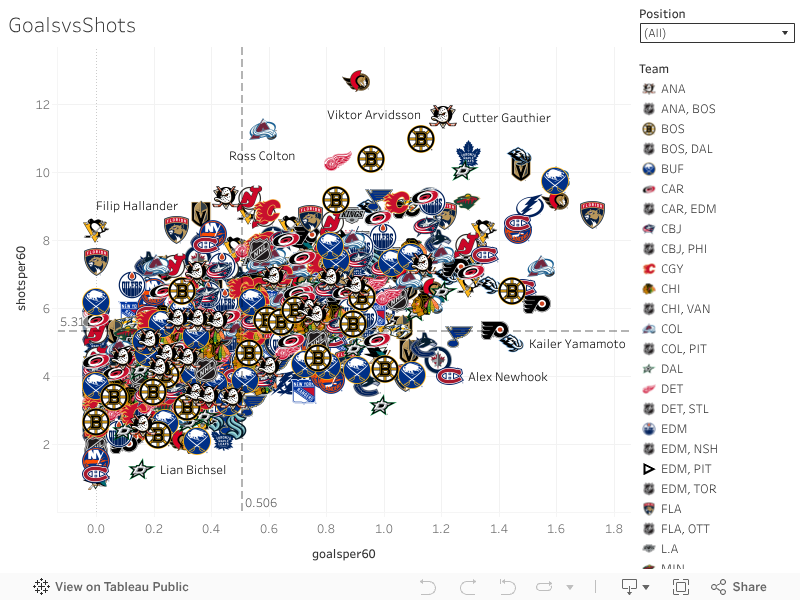
This one retains the identical shot quantity lens, however swaps in Targets/60 to indicate who has been changing on the highest price this season. It’s a fast solution to separate pure quantity shooters from the gamers who’re pairing quantity with ending. Dylan Guenther, Jack Eichel, Cutter Gauthier, and Auston Matthews stand out as high-end scorers on this view, whereas Brady Tkachuk once more exhibits up as one of the constant pepper-the-net profiles within the league. This chart just isn’t saying everybody close to the highest will keep there without end, as a result of ending can swing with taking pictures share variance, however it does spotlight the gamers who’ve mixed alternative, shot technology, and scoring contact into actual five-on-five manufacturing to date.
Graph 8: Hits vs Blocks
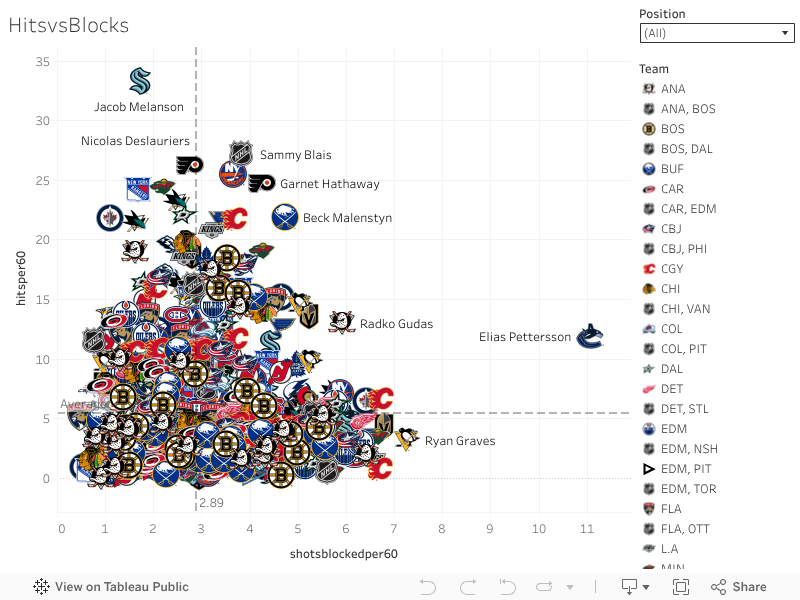
The ultimate participant chart strikes away from offense and into the peripherals layer: Hits vs. Blocks. That is the short learn for who’s actively partaking bodily, who’s getting in taking pictures lanes, and who’s doing neither. The underside-left space is the place gamers present little or no in both class, and that’s the place you see names like Kyle Connor and Artemi Panarin sitting nicely under the league-average reference line. It’s not a critique of their total worth; it’s only a clear sign of play fashion. You additionally see different expert gamers in that low-peripheral cluster who usually are not going to maneuver the needle in hits or blocks even when they’re productive offensively. In the meantime, the gamers greater up in both path are those who carry that additional class juice, both by enjoying heavy and ending checks, or by constantly getting in lanes and absorbing pictures.
Knowledge from MoneyPuck and the NHL API.